Retail Market: Record Sales, Falling Vacancy, and a Market Built to Last
By Bobbie Tibbetts
Bender Commercial Real Estate | 29th Annual Market Outlook Series | 8-minute read
The Sioux Falls retail market enters 2026 in a position most markets would envy: vacancy is down, rents are up, new construction is being absorbed, and investment sales hit record levels in 2025.
Over the past five years, the market added nearly one million square feet of retail inventory while vacancy fell from 13.3% to 8.0%. That combination of supply growth and vacancy reduction is not a coincidence — it is the result of demand-led development in a market where population growth is consistent, retail spending is healthy, and both national and local brands are planting their flags and actively expanding.
This post is part of Bender Commercial’s 29th Annual Market Outlook series, based on presentations given February 19, 2026. For more context, watch the full presentation video or see the companion posts on the Sioux Falls land, office, industrial, and multifamily markets.
Five Years of Supply Growth, Falling Vacancy
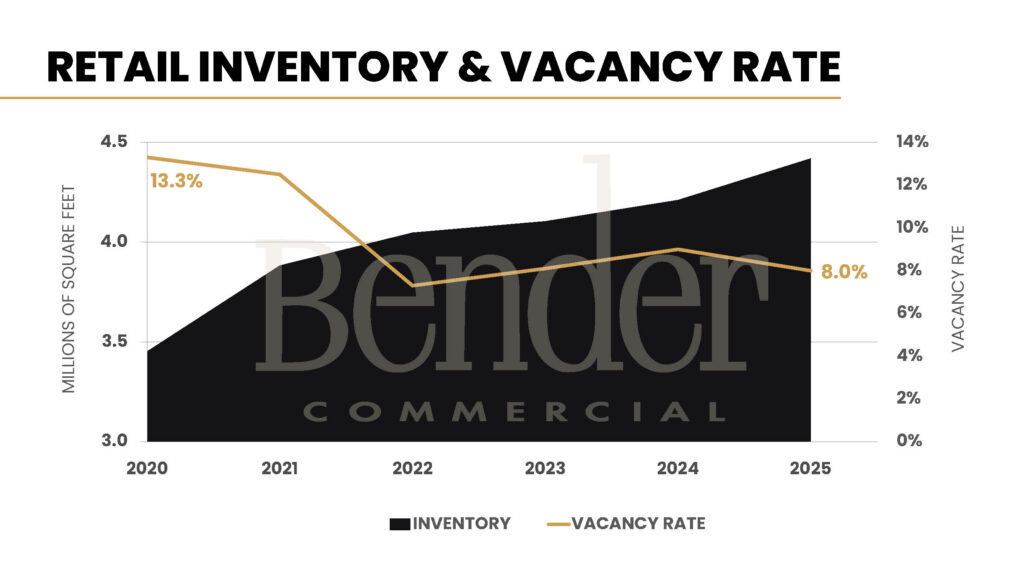
The chart above tells a story that defies the conventional supply-demand narrative. Sioux Falls added nearly one million square feet of retail inventory over five years while vacancy dropped more than five percentage points. New space was being built in corridors where population density and consumer spending patterns already supported investment.
For owners of existing retail assets, this trajectory matters: growing supply has not diluted values. It has validated and strengthened the trade area. The new development occurring in Sioux Falls is expanding the pie, not cannibalizing existing positions.
Sioux Falls Retail Vacancy by Submarket
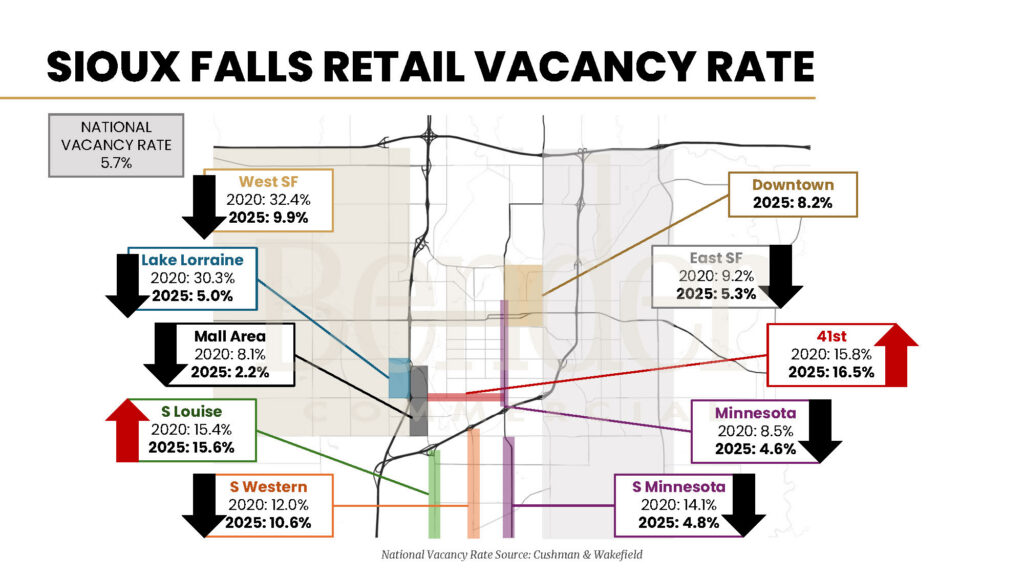
The submarket-level data reveals the depth of the improvement across Sioux Falls:
- Lake Lorraine: 30.3% vacancy in 2020 → 5.0% in 2025. One of the most dramatic retail recoveries in the market’s recent history.
- Mall Area: 8.1% → 2.2%. Among the tightest submarkets in the city — well below the national shopping center vacancy benchmark of 5.7%. (Source: Cushman & Wakefield)
- East SF: 9.2% → 5.3%. Steady, sustained improvement.
- South Minnesota (85th Street): 14.1% → 4.8%. Significant absorption in the lower corridor.
- West SF: 32.4% → 9.9%. Still above average, but a meaningful recovery from a very elevated starting point.
- Minnesota Avenue: 8.5% → 4.6%.
Two submarkets edged slightly higher: 41st Street from 15.8% to 16.5%, and South Louise Avenue remaining elevated at 15.6%. Both contain larger blocks of available space that take longer to absorb. They represent opportunity for users needing bigger footprints — not systemic weakness in the market.
Retail Rental Rates: Rising Across Sioux Falls
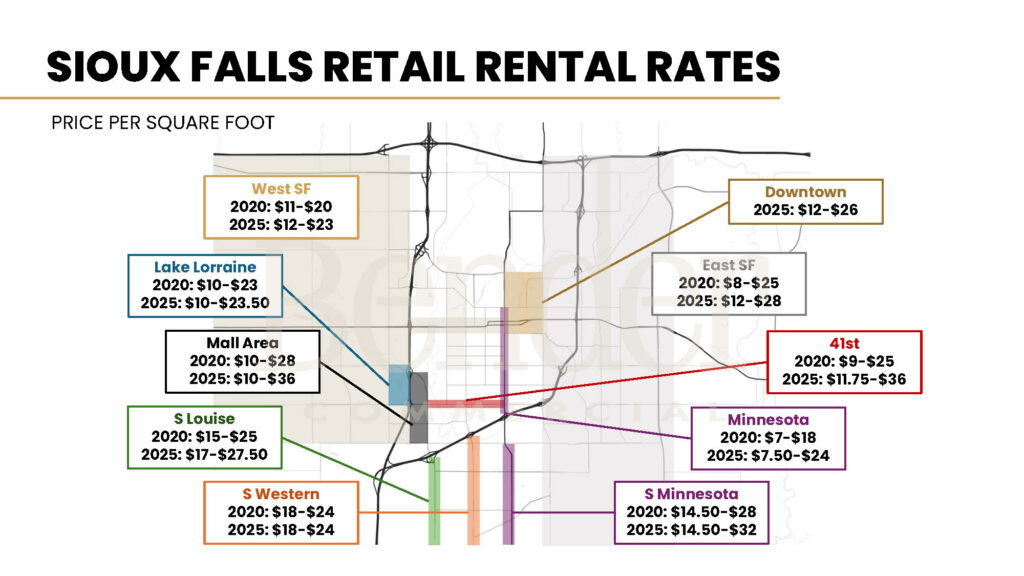
Rising rents across Sioux Falls’ highest-demand corridors confirm that the demand story is real and durable. Five-year rent movements:
- 41st Street: Upper end now at $11.75–$36/SF, up from $9–$25 in 2020 — upper end growth of 44%.
- Mall Area: $10–$36/SF, up from $10–$28. The top of the range has expanded significantly as the submarket tightened.
- South Minnesota: $14.50–$32/SF, up from $14.50–$28.
- South Louise: $17–$27.50/SF, up from $15–$25.
- West Sioux Falls: $12–$23/SF, up from $11–$20.
- Downtown: Currently at $12–$26/SF.
When rents rise across nearly every submarket simultaneously, it signals market-wide demand rather than isolated pockets of strength. Higher rents produce higher net operating income, and higher NOI is the engine that drives asset appreciation and supports investment valuations.
Sioux Falls Retail Investment Sales: Record Volume
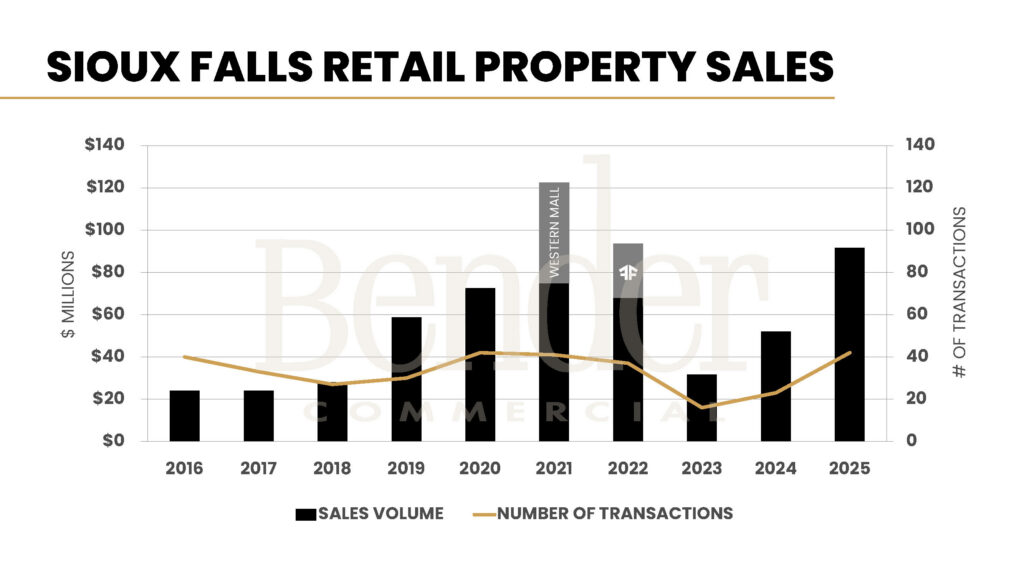
Sioux Falls retail investment sales matched the record high of 42 transactions in 2025 — tying the previous mark set in 2020. The more meaningful figure is total value: 2025 sales volume exceeded the prior record by approximately $20 million, reaching approximately $90 million. More transactions does not explain the higher value. Higher income per asset does.
Higher rents produce higher net operating income, and higher NOI supports higher valuations even at current cap rates. Add to that the fact that construction costs make new development expensive relative to acquiring existing product, and the result is strong buyer demand for stabilized retail assets. Both investors and owner-occupants are gravitating toward well-located existing retail.
National Brands Are Expanding in Sioux Falls
While the national retail narrative has been defined by store closures and contraction, the Sioux Falls story is one of expansion. National brands with rigorous site selection processes are actively committing to this market:
- Lululemon: Started as a temporary mall tenant, signed a long-term lease, and then significantly expanded in 2025 — a three-step progression signaling genuine trade area confidence.
- Chick-fil-A, Carhartt, Culver’s: Among the brands making new commitments to the Sioux Falls market.
Some closures occurred in 2025, including several Starbucks locations and a handful of boutiques. Starbucks is continuing to pay rent on its Sioux Falls locations while executing a broader operational restructuring nationally — a strategic business decision, not a market signal. Retail churn is a feature of healthy markets. The net trend in Sioux Falls is strongly positive.
One trend worth watching: national retailers are increasingly favoring smaller, more optimized store formats over larger footprints. This will influence how new retail space is designed and how existing large-format spaces get repositioned.
The Metro Effect: Regional Growth Fuels Retail Demand
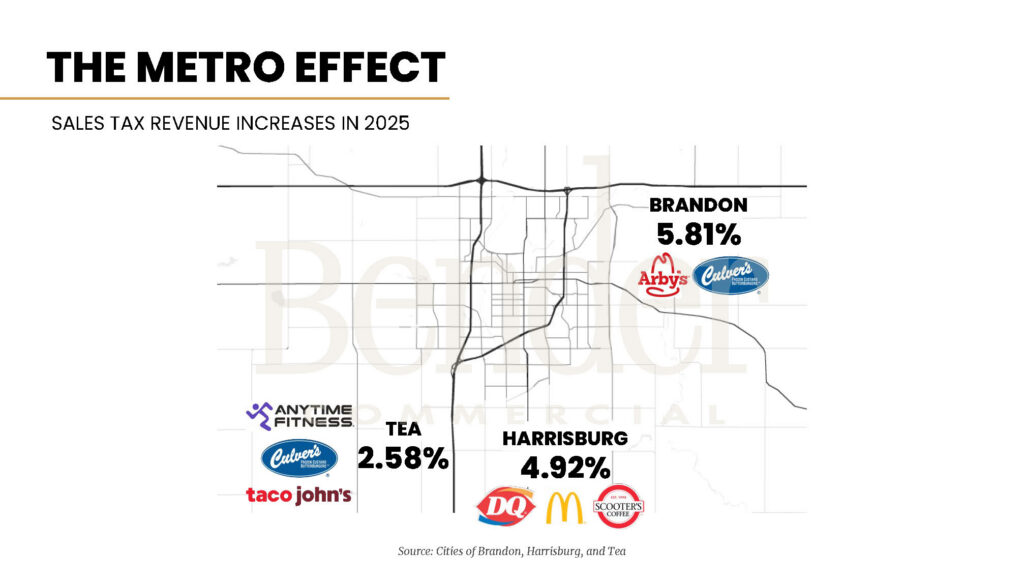
One of the structural advantages of the Sioux Falls retail market is the metro dynamic. When space tightens in Sioux Falls, surrounding communities absorb overflow demand and enable national brands to reach growing populations in Brandon, Tea, and Harrisburg.
The sales tax revenue data illustrates this directly. Even as statewide South Dakota sales tax revenue dipped slightly, Sioux Falls grew 2.4%, Brandon 5.81%, Harrisburg 4.92%, and Tea 2.58%. New brand entrants in metro communities in 2025 included Arby’s and Culver’s in Brandon; Dairy Queen, McDonald’s, and Scooter’s Coffee in Harrisburg; and Culver’s, Taco John’s, and Anytime Fitness in Tea.
This is not retail displacement — it is retail expansion serving a growing regional population. The metro retail market is a connected regional ecosystem, and its growth is happening from multiple nodes simultaneously.
Emerging Retail Corridors to Watch in 2026
Several areas of the Sioux Falls market are positioned for meaningful retail activity in the near term:
- Downtown rail yard area: An emerging corridor for mixed-use retail with development momentum building.
- Northwest Sioux Falls — Boyce Park: Commercial activity following residential growth in the northwest quadrant.
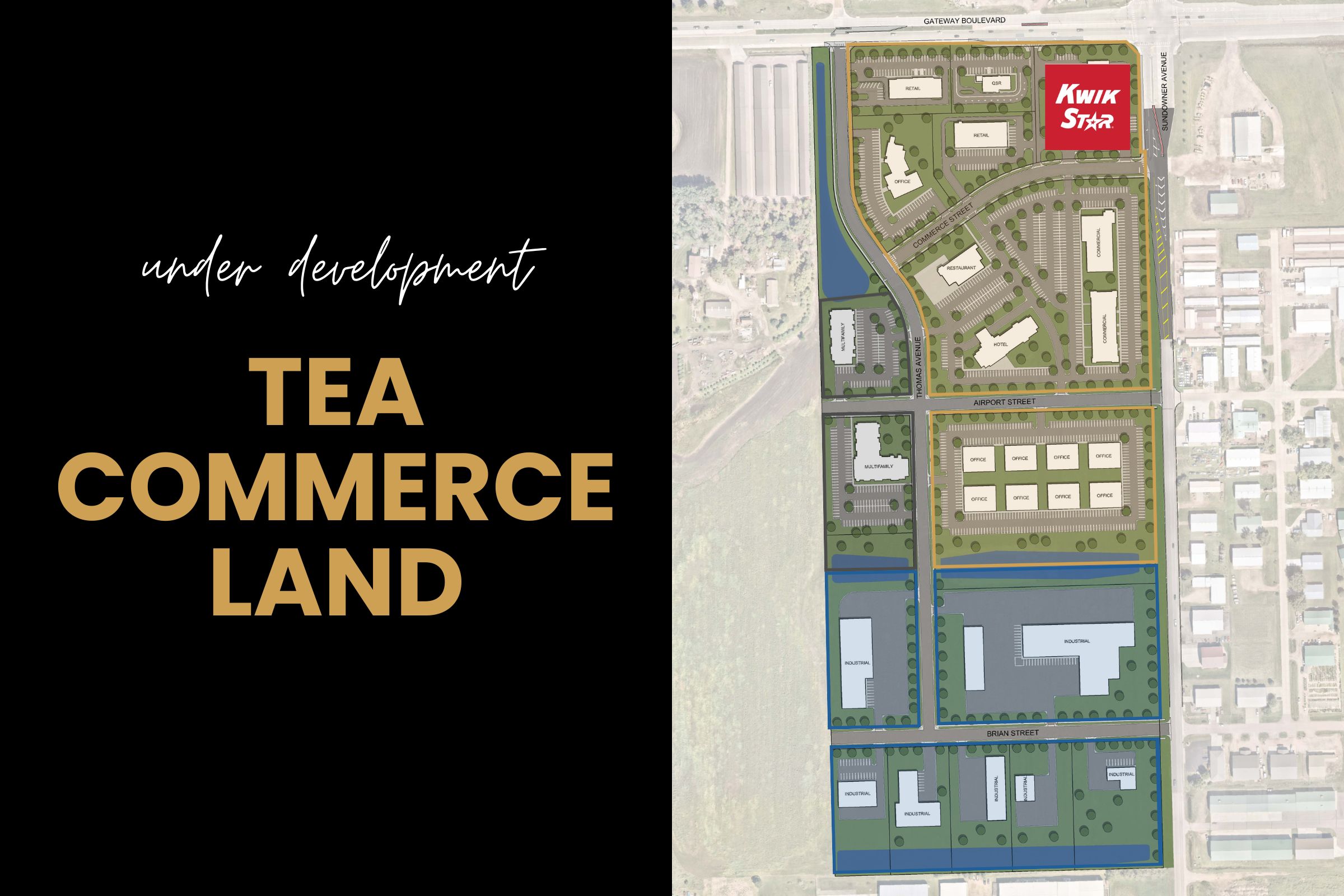
- Tea Commerce area: Active retail development in the Tea interchange corridor.
- 85th Street interchange (south Sioux Falls): Expect land activity and preliminary plan filings in 2026 before vertical construction follows.
The Sioux Falls retail market is not immune to broader economic pressures, but it is better positioned than most markets to navigate them. The fundamentals heading into 2026 are strong, and the metro growth story shows no signs of slowing.
Ready to talk about what this means for your real estate decisions?
Bender Commercial has guided clients through three decades of Sioux Falls market cycles. Whether you’re evaluating an investment, planning a move, or simply trying to understand what the data means for your business, we’d welcome the conversation.