Office Market: Stability, Strategic Repositioning, and a Path Forward
By Andi Anderson, SIOR & Isaac Jorgensen
Bender Commercial Real Estate | 29th Annual Market Outlook Series | 9-minute read
Office is the commercial real estate asset class that has faced the greatest disruption of the post-pandemic era. Nationally, the story has been dominated by hybrid work, corporate space rightsizing, distressed loans, and vacancy rates approaching 20% in major markets.
The Sioux Falls office market has not been immune to these forces — but it has navigated them far more successfully than most, and the data heading into 2026 points toward continued improvement.
This post is part of Bender Commercial’s 29th Annual Market Outlook series, based on presentations given February 19, 2026. For more context, watch the full presentation video or see the companion posts on the Sioux Falls land, retail, industrial, and multifamily markets.
The National Office Market: Understanding Why Sioux Falls Is Different
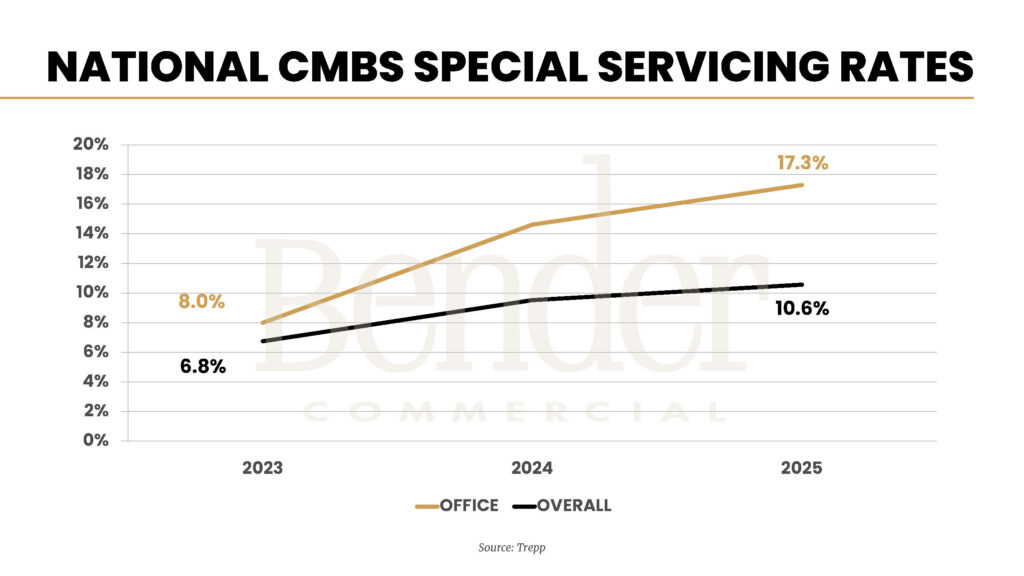
CMBS — commercial mortgage-backed security — special servicing rates track loans in financial distress. The national office rate reached 17.3% by end of 2025, rising from 8.0% in 2023. Nearly one in five securitized office loans nationally is in some form of distress. This reflects compounding pressures: reduced space utilization from hybrid work, lease expirations exposing above-market rents, and refinancing pressure as lower-rate debt matured into a higher-rate environment.
Sioux Falls has significantly lower exposure to these pressures. Although our market does have large corporate headquarters and financial services tenants, local loan structures tend to be smaller, more conservative, and carried by local and regional lenders rather than securitized in CMBS pools. That structural difference matters enormously when comparing Sioux Falls to the national picture.
Sioux Falls Office Vacancy Rate: 12.1% vs. the National 18.9%
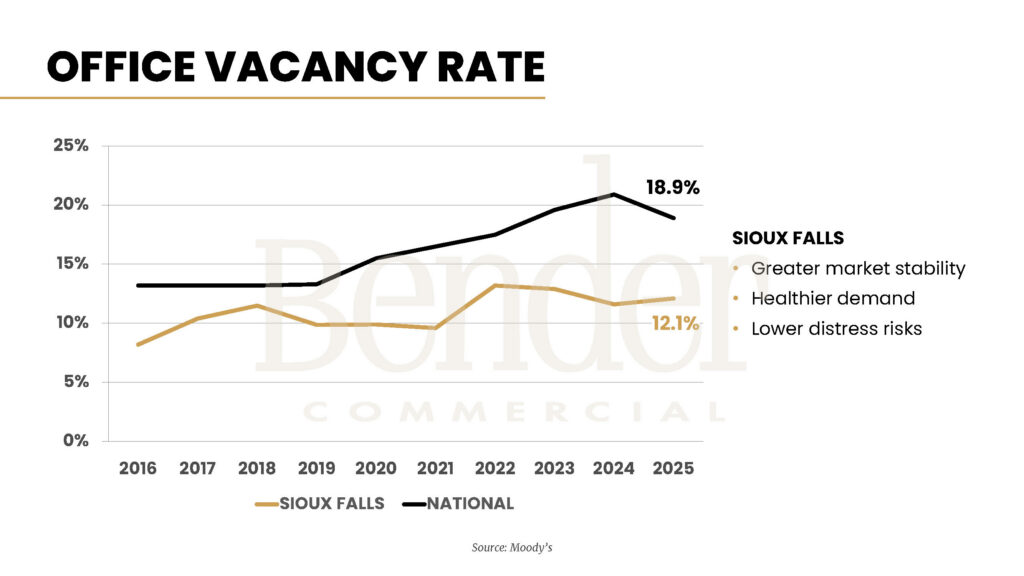
The Sioux Falls office market finished 2025 with an overall vacancy rate of 12.1% — well below the national average of 18.9%. That gap has persisted throughout the post-pandemic period and reflects greater market stability, healthier tenant demand, and meaningfully lower distressed risk than national benchmarks.
Context matters: Sioux Falls office vacancy was running in the 8–10% range before the pandemic. Not only has the local market weathered some disruption, but it has also absorbed new downtown office space in the Steel District and Cherapa II. The Sioux Falls market is navigating all of this without the forced selling and dramatic restructuring that characterize many larger markets.
What Sioux Falls Office Inventory Actually Looks Like
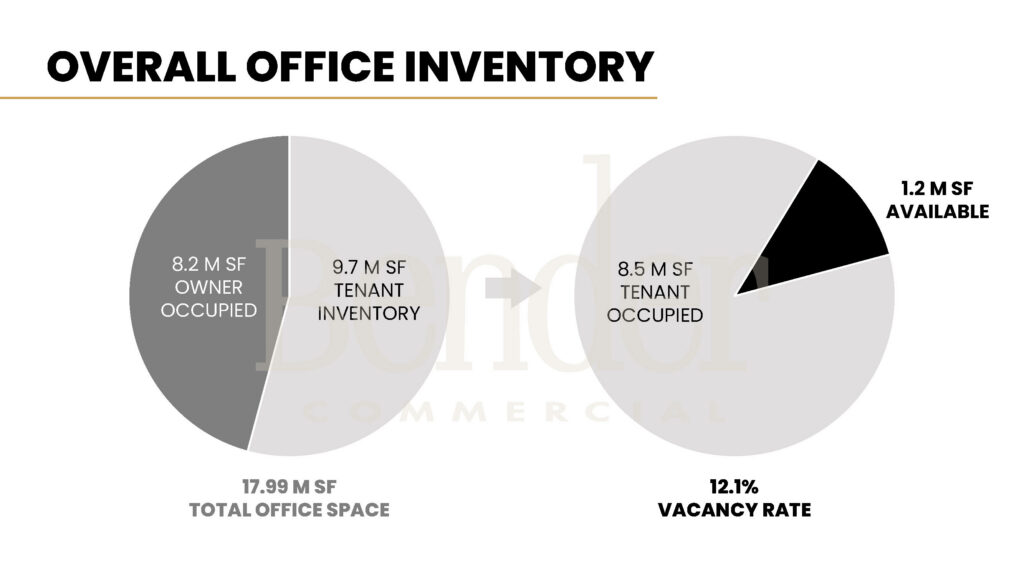
Sioux Falls has approximately 18 million square feet of office space. Of that, 8.2 million square feet is owner-occupied — used directly by businesses that own their buildings and does not factor into vacancy statistics. The relevant tenant inventory is the remaining 9.7 million square feet, of which 8.5 million is currently occupied and approximately 1.2 million square feet is available.
Downtown vs. Suburban: Two Different Sioux Falls Office Markets
Downtown Sioux Falls: 4.1% Vacancy
Downtown Sioux Falls finished 2025 with a vacancy rate of just 4.1% across 2.67 million square feet, with approximately 110,082 square feet available for lease. That is exceptionally tight.
Current downtown office lease rates:
- Class A: $24.00–$34.00 per SF NNN
- Class B: $14.50–$19.00 per SF NNN
- Class C: $10.00–$14.50 per SF NNN
The spread from Class A to Class C gives tenants with different budget profiles genuine options in a thriving downtown — which is healthy for the tenant ecosystem. Downtown tightness is now creating active conversation about whether the core can accommodate growing demand without new supply.
Suburban Sioux Falls: 15.2% Vacancy
Suburban Sioux Falls — everything outside of downtown — has 7.08 million square feet of total inventory and a 15.2% vacancy rate, leaving approximately 1,073,573 square feet available.
Current suburban office lease rates:
- Class A: $18.00–$26.00 per SF NNN
- Class B: $12.50–$18.00 per SF NNN
- Class C: $8.00–$12.50 per SF NNN
The suburban rate structure is meaningfully lower than downtown, reflecting the supply overhang and the competitive dynamics of a market working through available space. For tenants seeking value and flexibility, the suburban market offers options the tight downtown cannot.
The Large-Block Vacancy Story: Why the Real Number May Be 2.7%
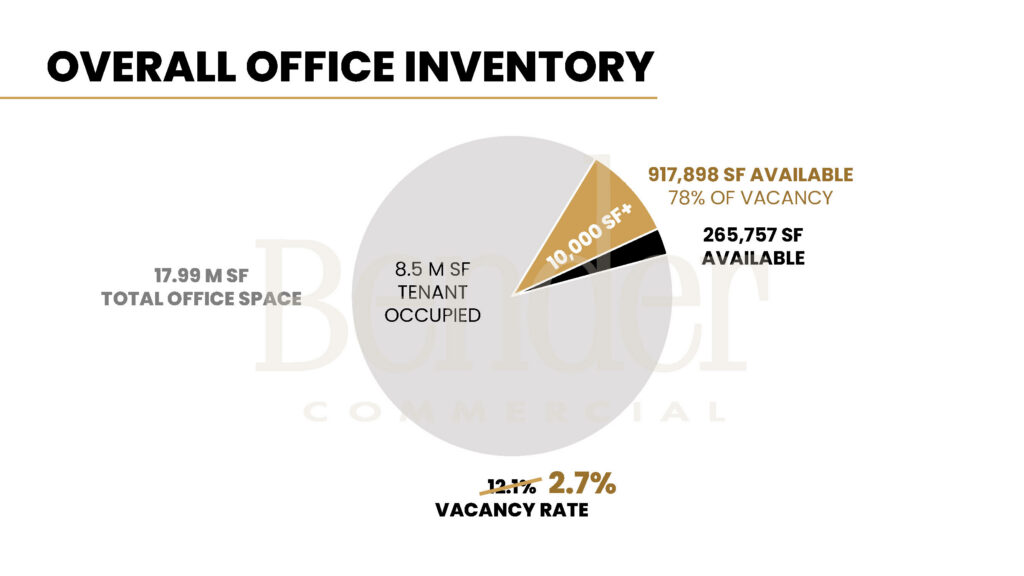
The most important nuance in the Sioux Falls office market is buried inside the 12.1% overall vacancy figure. Of the approximately 1.2 million square feet currently available, roughly 917,898 square feet — approximately 78% of all vacancy — sits in blocks larger than 10,000 square feet. Small suites under 10,000 square feet account for only about 265,757 square feet of available space.
If large-block vacancy is excluded, the effective vacancy rate for the small-suite market drops from 12.1% to approximately 2.7%. That is an extraordinarily tight market for professional services firms, healthcare users, financial advisors, and other businesses that typically occupy smaller suites. For this segment of the market, finding available space is genuinely competitive.
Large-block vacancy represents a structural challenge that will not resolve through normal leasing activity. Former call centers, large corporate suites, and older suburban buildings are not going to be re-leased at their original use. The path forward involves repositioning, adaptive reuse, owner-occupant acquisition, or conversion. That process is actively underway — and 2025 provided compelling examples.
Notable Sioux Falls Office Sales in 2025
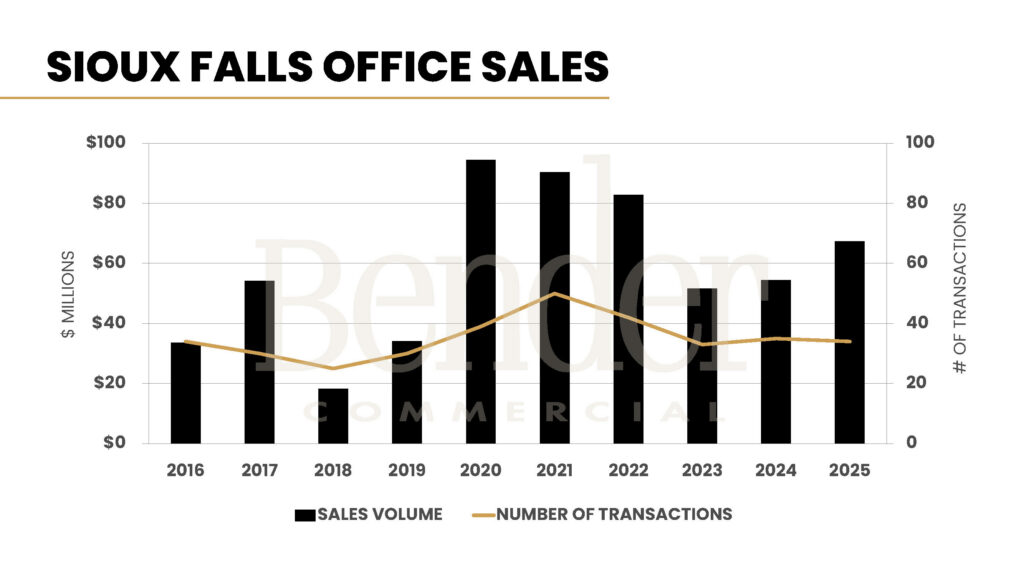
Sioux Falls recorded 34 office sales transactions totaling $67 million in 2025, with per-square-foot pricing ranging from approximately $40 to over $400. Five transactions illustrate the range of activity:
- 4409 S Technology Drive — Collision ($105.85/SF, $1,287,500): A 12,164 SF former call center building acquired by a local nonprofit. A clear example of large-format suburban space being absorbed through adaptive reuse.
- 116 W 69th Street — Urology Specialists ($261.57/SF, $4,500,000): A 17,204 SF building acquired by an owner-occupant medical practice with a market-rate tenant providing income on the upper floor. Medical users have been a consistent source of suburban office demand.
- 3500 S Sheldon Lane — Falls Dental ($200.83/SF, $1,205,000): A 6,000 SF building purchased by the existing tenant from the landlord. No vacancies, right-sized suites, and a tenant who knows the building well.
- 2500 E 52nd Street North — GameDay Social ($97.31/SF, $4,350,000): A 44,704 SF building acquired for under $100 per square foot by a growing Sioux Falls business with a vision to reimagine the space as they expand.
- 141 N Main Street — AC Hotels by Marriott ($49.39/SF, $5,165,000): The US Bank Building sold for adaptive reuse, with US Bank continuing to occupy the lower levels and an AC Hotels by Marriott property planned above. One of the most significant downtown repositioning projects in years.
How Tenants Are Making Decisions Differently
Beyond the sales data, a notable behavioral shift is occurring among Sioux Falls office tenants. Rather than defaulting to lease renewal, tenants are approaching space decisions more deliberately. The questions being asked: How much space do actual attendance patterns require? What does our total occupancy cost — including triple net expenses — look like over a five-year lease? How do we balance workstation density with collaboration space?
This deliberateness is healthy for the market over time. Tenants who have right-sized their space to actual utilization are more stable occupants. Triple net expenses — property taxes, insurance, and maintenance — continue to increase across the market, and this is becoming a significant factor in lease negotiations. Landlords who understand their tenants’ functional needs are best positioned to retain them through renewals.
Sioux Falls Office Market Outlook for 2026
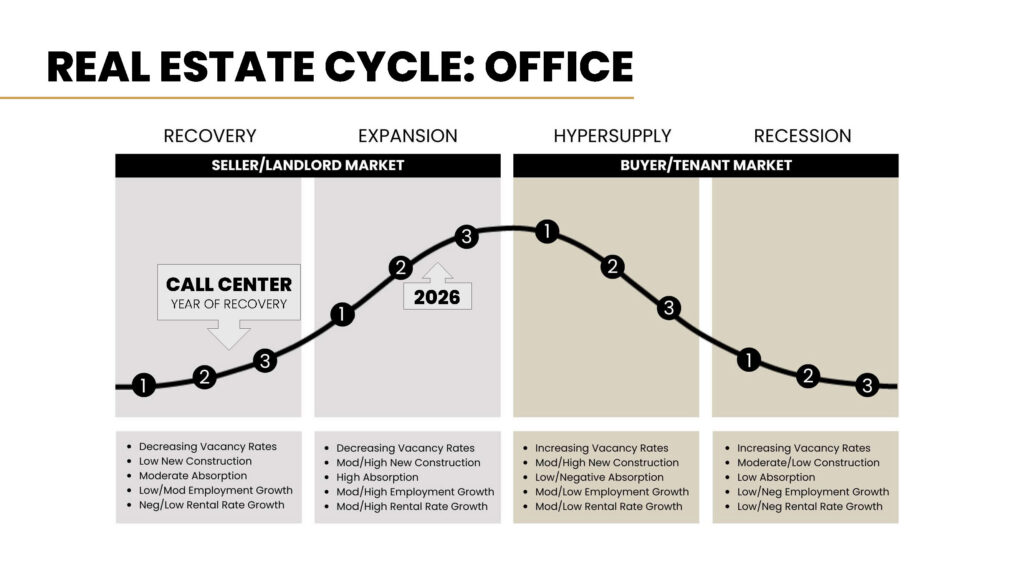
The Sioux Falls office market is positioned in the expansion phase of the real estate cycle heading into 2026 — driven by strong small-suite demand, a thriving downtown, and active buyer interest in repositionable suburban assets. Call center space is expected to enter a recovery phase as buyers increasingly recognize the value in large-format buildings.
Bender Commercial predicts that 2026 will mark the first year since 2021 with more than 40 Sioux Falls office sale transactions, driven by owner-occupant buyers and new product anticipated to come to market. For businesses evaluating office space for lease in Sioux Falls, or investors considering office acquisitions in South Dakota, the Bender Commercial office team has deep experience in both the downtown and suburban markets.
Ready to talk about what this means for your real estate decisions?
Bender Commercial has guided clients through three decades of Sioux Falls market cycles. Whether you’re evaluating an investment, planning a move, or simply trying to understand what the data means for your business, we’d welcome the conversation.